
How Aligner Sheets Thickness Affects Clear Aligner Performance
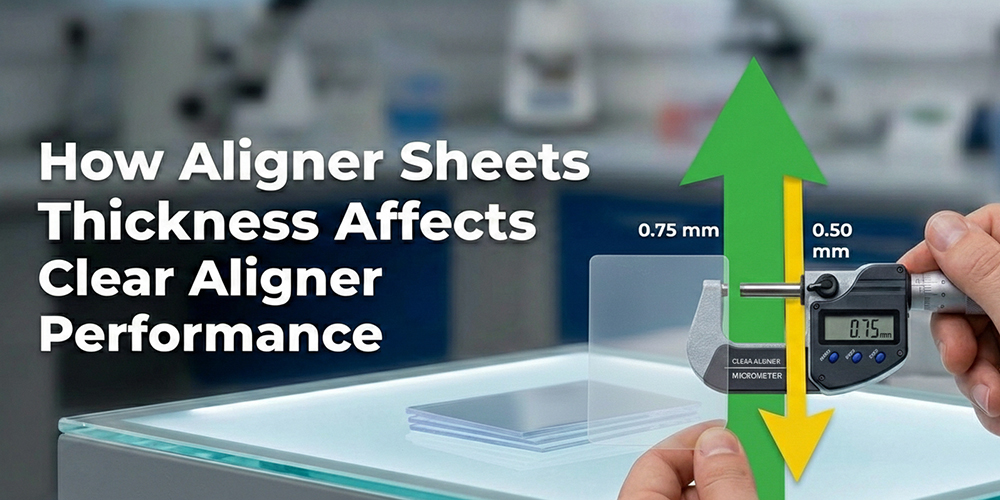
Aligner sheets thickness sounds like a small detail.
It isn’t.
It’s one of those things nobody worries about at first.
Until aligners crack.
Or feel uncomfortable.
Or just stop moving teeth the way they should.
If you’ve ever asked yourself:
“Why does this aligner feel too stiff?”
“Why does retention drop halfway through treatment?”
“Am I using the right thickness, or just what everyone else uses?”
You’re not overthinking it.
You’re asking the right question.
And it all comes back to aligner sheets thickness.
Why thickness matters more than material alone
Most people obsess over material.
PETG vs TPU.
Single-layer vs multi-layer.
Material matters.
But thickness decides how that material behaves in real life.
Same PETG.
Different thickness.
Completely different clinical outcome.
Thickness controls three things that actually move the needle:
Force delivery
Patient comfort
Durability across wear time
Get thickness wrong.
And even the best material underperforms.
What “aligner sheets thickness” really changes in practice
Let’s keep this practical.
Thickness directly affects:
Initial force applied to the tooth
Force decay over time
Flexibility during insertion and removal
Crack resistance after thermoforming
That’s not theory.
That’s daily lab reality.
Thin aligner sheets (0.5–0.6mm): where they shine, where they fail
Thin sheets are popular for a reason.
They’re:
Easier to thermoform
More comfortable for patients
Less noticeable in the mouth
But here’s the trade-off nobody likes talking about.
Thin aligners:
Deliver lighter forces
Lose force faster
Deform more easily after a few days
They work well for:
Minor movements
Refinement stages
Short wear cycles
They struggle with:
Complex movements
Long wear intervals
Patients who are rough on aligners
Thin doesn’t mean bad.
It just means limited.
Medium thickness (0.75mm): the industry workhorse
If there’s a “safe zone” in aligner sheets thickness, this is it.
0.75mm sits right in the middle.
Enough rigidity to move teeth.
Enough flexibility to stay comfortable.
Clinically, this thickness:
Balances force and comfort
Holds shape better over time
Works across most treatment stages
That’s why many labs default to it.
Not because it’s perfect.
Because it’s predictable.
For PETG thermoforming sheets, this thickness is often the sweet spot.
Thick aligner sheets (1.0mm+): power with a price
Thicker aligners look impressive on paper.
More material.
More strength.
More force.
But more isn’t always better.
Thicker sheets:
Deliver higher initial force
Feel stiffer during insertion
Can reduce patient compliance
They’re useful when:
Significant tooth movement is required
Retention is the top priority
Aligners need to last longer per stage
They become a problem when:
Comfort drops
Patients struggle to seat aligners
Excess force causes unwanted side effects
Thickness should match the job.
Not ego.
Thermoforming changes thickness more than you think
Here’s something labs learn the hard way.
The thickness you buy
is not the thickness you end up with.
During thermoforming:
Material stretches
Thickness reduces unevenly
Occlusal and gingival areas behave differently
That means a “0.75mm sheet”
might end up thinner in critical zones.
This is why consistent PETG quality matters.
And why sheet uniformity isn’t a small detail.
Low-quality sheets exaggerate thinning.
High-quality PETG holds structure better.
One thickness for all stages? That’s lazy thinking
Real talk.
Using the same aligner sheets thickness for every stage is convenient.
It’s also limiting outcomes.
Smarter approach:
Thinner sheets for initial alignment
Medium thickness for controlled movement
Thicker sheets for retention
You don’t need more complexity.
You need intentional choices.
How I’d choose thickness if I were running a lab today
Here’s my no-BS framework.
I’d ask three questions:
What movement is required?
How long is each wear cycle?
How compliant is the patient group?
Then I’d match thickness to reality.
Not trends.
Not supplier hype.
And I’d test.
Always test.
Common mistakes I see with aligner sheets thickness
I see the same errors again and again.
Choosing thickness based on price alone
Copying competitors without understanding why
Ignoring thermoforming shrinkage
Assuming thicker = better results
None of these are strategy.
They’re shortcuts.
FAQs
What is the best aligner sheets thickness for PETG?
There is no single “best” thickness.
0.75mm is commonly used because it balances force and comfort.
Final choice depends on treatment stage and movement complexity.
Does thicker aligner mean faster tooth movement?
Not necessarily.
Too much force can reduce efficiency and comfort.
Controlled force beats brute force every time.
Does thermoforming reduce aligner thickness?
Yes.
All thermoforming processes reduce thickness to some degree.
Higher-quality PETG reduces uneven thinning.
Should labs stock multiple thickness options?
Absolutely.
Different stages and cases need different mechanical behaviour.
One thickness limits flexibility.
Final thought
If you want better clinical outcomes, stop treating aligner sheets thickness like a minor spec.
It’s not.
It’s a performance lever.
And once you start choosing thickness intentionally,
everything else works better.
Inquire Us Now
We will Get Back to You soon