
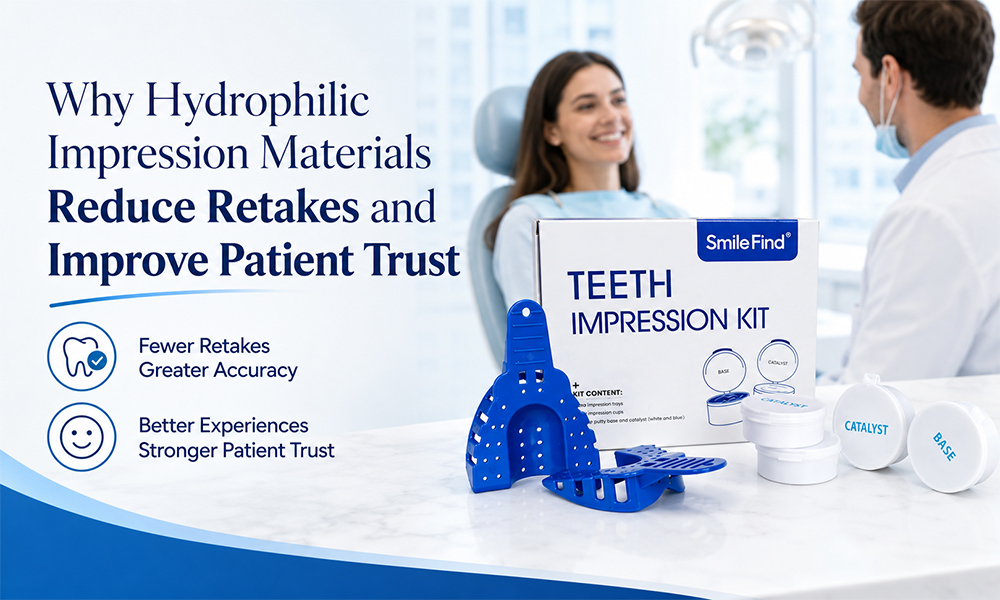
Why Hydrophilic Impression Materials Reduce Retakes and Improve Patient Trust
Every dentist knows the moment: the impression comes out of the mouth, and instead of a clean, detailed negative of the preparation margin, there’s a void, a bubble, or a blurred edge where saliva pooled during setting. The tray goes back in. The patient sighs. The schedule slips by another ten minutes.
Retakes are treated as a routine inconvenience in most practices, but they are rarely just about wasted material. Each retake adds chair time, delays the next patient, and — perhaps most importantly — chips away at something harder to measure: the patient’s confidence that the procedure is being done right the first time.
The root cause of many retakes is more predictable than it seems, and it comes down to a single material property: hydrophilicity. Understanding what this term actually means, and why it matters clinically, helps explain why some impressions consistently capture crisp detail in a wet oral environment while others don’t.
What Does "Hydrophilic" Actually Mean in Dental Impression Materials?
In simple terms, a hydrophilic material has a natural affinity for water — it wets a surface easily and spreads across it, rather than beading up and rolling off. A hydrophobic (or non-hydrophilic) material does the opposite: water forms droplets on its surface and resists even, uniform contact.
This distinction matters enormously in dentistry because the mouth is never truly dry. Saliva, crevicular fluid, and moisture from soft tissue are constant variables that the impression material has to work around, not despite.
Most addition-cured silicone (VPS) materials are inherently hydrophobic in their base chemistry. To perform reliably in a clinical setting, manufacturers add surfactants that lower the material’s surface tension, allowing it to wet moist dentition and soft tissue effectively. This modification is what gives VPS materials their practical hydrophilicity — and it is measured, in technical terms, by the material’s contact angle with water. A lower contact angle indicates better wetting behavior and, generally, better performance in the kind of moist conditions found in a real patient’s mouth.
Industry standards such as ISO 4823 outline benchmarks for detail reproduction, dimensional change, and elastic recovery in elastomeric impression materials — providing a reference point for evaluating whether a material’s wetting properties translate into consistent clinical performance, not just favorable numbers on a data sheet.
The Real Cost of Retakes — Beyond Just Material Waste
When a retake happens, the most visible cost is the material itself — a wasted cartridge or putty set. But that is usually the smallest part of the equation.
Consider what actually happens during a retake:
- Chair time doubles for that step of the procedure, pushing back every subsequent appointment that day.
- The patient sits longer with a tray in their mouth, often for a second or third attempt, which is rarely a pleasant experience.
- The clinical team’s workflow is disrupted, adding friction to a day that was already tightly scheduled.
- If the impression is sent to an external lab, a poor impression may not be caught until the model is poured — meaning the patient has to be brought back for an entirely new visit.
None of these costs show up neatly on a supply invoice, but they accumulate. A practice with a chronically high retake rate isn’t just spending more on materials — it is quietly spending more staff time, losing scheduling efficiency, and, over time, shaping how patients perceive the practice.
This is the less obvious cost: patients notice when a procedure doesn’t go smoothly the first time. Even when they don’t say anything, a retake plants a small seed of doubt — was that necessary? Is this normal? Should I be worried about the result? For a practice that depends on repeat visits and referrals, that seed of doubt is worth taking seriously.
How Hydrophilicity Directly Reduces the Need for Retakes
The clinical mechanism behind this is straightforward. When an impression material is placed against a moist surface — a subgingival margin, an implant site, or tissue near the gingival sulcus — its ability to wet that surface determines how well it captures fine detail.
A hydrophilic material spreads evenly across the moist surface, displacing the thin film of saliva or crevicular fluid and flowing into fine anatomical detail before it sets. The result is a sharp, continuous impression of the margin, free of voids.
A hydrophobic or poorly wetting material behaves differently in the same environment. Instead of displacing moisture, it tends to resist it — fluid collects in small pockets rather than being pushed aside, and those pockets become voids or blurred areas once the material sets. In cases involving subgingival margins or implant impressions, where fine detail is clinically critical, this failure mode is one of the most common reasons an impression has to be retaken.
Put simply: in a dry, controlled laboratory setting, the difference between a hydrophilic and non-hydrophilic material might be negligible. In the mouth — where moisture is a constant, uncontrollable variable — that difference becomes the deciding factor in whether an impression is usable the first time.
From Fewer Retakes to Higher Patient Trust — Connecting the Dots
It’s worth stepping back and translating the clinical mechanism into what the patient actually experiences.
Fewer retakes mean shorter appointments, less time with a tray held in place, and fewer moments where something visibly “goes wrong” during treatment. For a patient who is already anxious about dental visits — and many are — a smooth, efficient impression procedure reinforces a simple but powerful impression: this practice knows what it’s doing.
The inverse is also true. It is widely understood within the dental industry that patient experience during routine procedures has a direct relationship with how patients rate their visit, whether they return for follow-up treatment, and whether they recommend the practice to others. A procedure that requires multiple attempts — even for reasons entirely unrelated to the clinician’s skill — can quietly undermine that confidence.
In this sense, a material property as technical as hydrophilicity ends up having a very human consequence: it shapes whether a patient leaves the chair feeling like the visit went smoothly, or feeling like something didn’t quite work as it should have.
What to Look for When Choosing a Hydrophilic Impression Material
For practices and labs evaluating impression materials, hydrophilicity isn’t something that can be judged by a marketing claim alone. A few practical points are worth checking:
- Contact angle data. Look for materials that publish or can provide contact angle measurements — lower values generally indicate better wetting performance in moist conditions.
- Thixotropic behavior. A good hydrophilic material should also be thixotropic — staying in place when loaded into a tray, but flowing readily under the pressure of seating, so it can reach fine detail without slumping.
- Elastic recovery and dimensional stability. Wetting performance only matters if the material also holds its shape accurately after removal; the two properties need to work together.
- Third-party test reports or certifications. Materials manufactured under recognized quality systems (such as ISO 13485) and backed by test documentation offer more assurance than performance claims alone.
These four factors, taken together, are a more reliable way to evaluate a material’s real-world performance than relying on a single word like “hydrophilic” printed on the packaging.
FAQ
What makes an impression material “hydrophilic”?
A hydrophilic impression material has a low contact angle with water, meaning it spreads evenly across a moist surface instead of forming droplets. This allows it to displace saliva and crevicular fluid and flow into fine detail before setting, rather than trapping moisture and creating voids.
Are all VPS (silicone) impression materials hydrophilic by default?
No. Most addition-cured silicones are inherently hydrophobic in their base chemistry. Manufacturers add surfactants to lower surface tension and improve wetting behavior — the resulting hydrophilicity varies by formulation, which is why contact angle data and third-party test reports are worth checking rather than assuming based on the material category alone.
How does hydrophilicity actually reduce the number of retakes?
In moist areas such as subgingival margins or implant sites, a hydrophilic material wets the surface evenly and captures fine anatomical detail on the first attempt. A poorly wetting material tends to trap moisture in small pockets, which shows up as voids or blurred margins — one of the most common reasons an impression has to be redone.
Does a lower retake rate really affect patient trust?
Indirectly, yes. Fewer retakes mean shorter appointments, less time with a tray in place, and fewer visible signs that something didn’t go smoothly. Patient experience during routine procedures is closely tied to how patients perceive a practice’s competence and whether they return or refer others.
What should I check before choosing a hydrophilic impression material for my practice or lab?
Look beyond the word “hydrophilic” on the packaging. Check for published contact angle data, thixotropic behavior (so the material stays in place but flows under pressure), elastic recovery and dimensional stability, and manufacturing under a recognized quality system such as ISO 13485.
Conclusion
Hydrophilicity is often treated as a minor technical spec buried in a product data sheet, but its impact on day-to-day practice is anything but minor. It directly affects whether an impression captures the detail needed the first time — and that, in turn, affects chair time, lab turnaround, and ultimately, how confident a patient feels about the care they’re receiving.
For practices looking to reduce retakes and build a smoother, more trustworthy patient experience, understanding the science behind material wetting is a good place to start.
SmileFind® manufactures FDA and CE-certified hydrophilic VPS impression materials for dental clinics, laboratories, and distributors worldwide. Explore our silicone impression kits or request a free sample to see the difference in your next case.
Inquire Us Now
We will Get Back to You soon