
PMMA Disc vs Zirconia Disc: What Should a Growing CAD/CAM Lab Stock First?
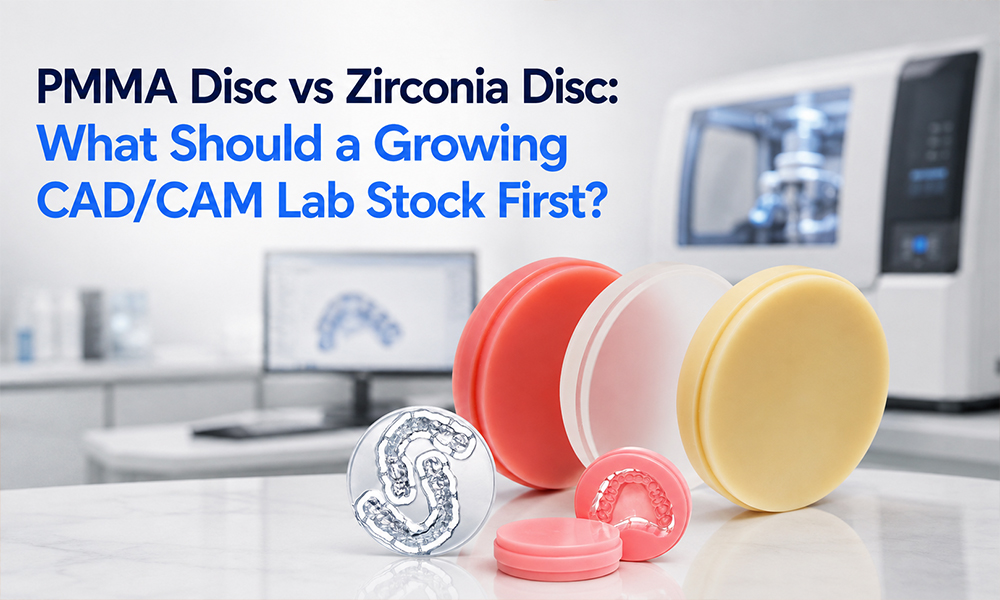
The rapid development of digital dentistry has changed the way dental laboratories design and manufacture restorations. With advanced CAD/CAM technology, dental labs can improve production efficiency, reduce manual processing time, and deliver more consistent restoration quality.
However, as more laboratories adopt digital workflows, choosing the right milling materials has become an important decision.
Many growing CAD/CAM labs face a common question:
Should you invest in PMMA Disc or Zirconia Disc first?
Both materials are essential in modern dental milling workflows, but they serve different purposes.
Dental PMMA Disc is widely used for temporary restorations, denture applications, and trial restorations due to its fast processing and cost efficiency. Meanwhile, Zirconia Disc is known for its superior strength, durability, and suitability for permanent restorations.
Understanding the differences between PMMA Disc vs Zirconia Disc can help dental laboratories optimize inventory, control costs, and select the right materials for different clinical applications.
Understanding Dental PMMA Disc
What Is a PMMA Disc?
PMMA (Polymethyl Methacrylate) is a polymer-based material widely used in dental CAD/CAM milling workflows.
A Dental PMMA Disc is designed for dental milling machines to produce accurate restorations with efficient processing and reliable aesthetic performance.
PMMA discs are commonly used for:
- Temporary crowns
- Temporary bridges
- Denture bases
- Implant trial restorations
- Diagnostic models
- Long-term provisional restorations
One of the biggest advantages of PMMA is that it can be milled quickly without requiring a sintering process, making it an efficient choice for dental laboratories that need faster production cycles.
Advantages of PMMA Disc for Dental Labs
Faster Milling and Processing
For growing CAD/CAM laboratories, production efficiency is a key factor.
Compared with ceramic materials, PMMA discs are easier to process and require fewer production steps.
The main advantages include:
- Easy milling process
- Short production cycle
- Reduced processing time
- Lower tool wear
For dental labs handling large volumes of temporary restorations, PMMA provides an efficient and cost-effective solution.
Cost-Effective Material Choice
Material cost is an important consideration for dental laboratories, especially when managing high-volume cases.
PMMA discs offer an economical option for temporary restorations and trial applications while maintaining reliable quality.
They are suitable for:
- High-volume temporary restorations
- Trial fitting procedures
- Digital workflow verification
- Dental education applications
By using PMMA for appropriate cases, labs can improve workflow efficiency while controlling production costs.
Excellent Aesthetic Options
Modern PMMA discs are available in different shades and multilayer structures to achieve more natural-looking results.
Multilayer PMMA Disc technology provides gradual color transitions, helping dental technicians create restorations with improved aesthetic performance.
This makes PMMA suitable for both functional and aesthetic temporary restoration applications.
Understanding Zirconia Disc
What Is a Zirconia Disc?
Zirconia is a high-strength ceramic material widely used in modern restorative dentistry.
A Zirconia Disc is milled through CAD/CAM equipment and then processed through sintering to achieve its final mechanical properties.
Zirconia discs are commonly used for:
- Permanent crowns
- Dental bridges
- Implant restorations
- Full-contour restorations
- High-strength dental applications
Because of its excellent durability and strength, zirconia has become one of the most popular materials for permanent dental restorations.
Advantages of Zirconia Disc
Superior Strength and Durability
The biggest advantage of zirconia is its outstanding mechanical performance.
Compared with polymer-based materials, zirconia provides:
- High flexural strength
- Excellent fracture resistance
- Long-term durability
These properties make zirconia an ideal choice for restorations that require long-term stability.
Suitable for Permanent Restorations
Zirconia discs are widely used for cases where strength and durability are priorities.
Typical applications include:
- Single crowns
- Multiple-unit bridges
- Posterior restorations
- Implant-supported restorations
For dental labs focusing on premium restorative solutions, zirconia is an essential material.
Premium Aesthetic Solutions
With advances in multilayer zirconia technology, modern zirconia discs provide improved translucency and more natural aesthetics.
Multilayer zirconia combines:
- High strength
- Better light transmission
- Natural color gradients
This makes zirconia suitable for demanding aesthetic restoration cases.
PMMA Disc vs Zirconia Disc: Key Differences
Although both materials are important CAD/CAM dental materials, PMMA and zirconia serve different purposes.
| Comparison | PMMA Disc | Zirconia Disc |
|---|---|---|
| Material Type | Polymer resin | High-strength ceramic |
| Main Application | Temporary restorations | Permanent restorations |
| Strength | Medium strength | High strength |
| Processing | Fast milling, no sintering required | Milling + sintering process |
| Cost | More economical | Higher material investment |
| Workflow | Faster production cycle | Longer processing time |
Which Material Should a Growing CAD/CAM Lab Stock First?
There is no single answer because every dental laboratory has different customer demands and production workflows.
The right choice depends on the type of cases your lab handles most frequently.
Choose PMMA Disc First If Your Lab Needs:
Faster Production
PMMA is ideal for laboratories that need shorter turnaround times.
Benefits include:
- Quick milling
- Easy processing
- Efficient workflow
Better Cost Control
For temporary restorations and high-volume production, PMMA helps reduce material costs.
Temporary Restoration Solutions
PMMA is commonly used for:
- Temporary crowns
- Temporary bridges
- Trial restorations
- Implant planning
Choose Zirconia Disc If Your Lab Focuses On:
Permanent Restorations
Zirconia is better suited for long-term clinical applications.
High-Strength Requirements
Ideal for cases requiring:
- Durability
- Fracture resistance
- Long service life
Premium Dental Solutions
For laboratories producing high-value aesthetic restorations, zirconia provides excellent performance.
Why Many CAD/CAM Labs Need Both PMMA and Zirconia
Instead of replacing one material with another, many successful CAD/CAM laboratories use PMMA and zirconia as complementary materials.
A typical digital workflow may include:
PMMA Disc → Temporary restoration / trial design
↓
Zirconia Disc → Final permanent restoration
By maintaining both materials, dental laboratories can:
- Support more clinical cases
- Improve production flexibility
- Offer complete restoration solutions
- Increase customer satisfaction
For growing CAD/CAM labs, building a balanced inventory is often more effective than choosing only one material.
How to Build an Efficient CAD/CAM Material Inventory
1. Analyze Your Case Types
Before purchasing milling materials, dental laboratories should evaluate their most common applications.
Consider:
- Temporary restoration volume
- Crown and bridge cases
- Implant restoration requirements
- Aesthetic restoration demand
2. Balance Cost and Production Speed
Material selection should consider:
- Material cost
- Milling efficiency
- Production capacity
- Final restoration requirements
Choosing the right combination of materials can improve both profitability and workflow efficiency.
3. Work With a Reliable Dental Material Supplier
A stable dental material supplier helps laboratories maintain consistent quality and optimize their digital workflow.
A professional supplier should provide:
- Different PMMA disc options
- Multilayer PMMA solutions
- Stable batch quality
- Technical support
Conclusion
Both PMMA Disc and Zirconia Disc play important roles in modern CAD/CAM dentistry, but they are designed for different applications.
PMMA Disc is an excellent choice for fast production, temporary restorations, and cost-efficient workflows.
Zirconia Disc provides superior strength, durability, and is ideal for permanent restorations.
For growing CAD/CAM dental laboratories, the best strategy is not always choosing one material over another. A balanced inventory that includes both PMMA and zirconia allows labs to handle more cases, improve production efficiency, and provide complete dental restoration solutions.
By selecting the right CAD/CAM dental materials, dental laboratories can build a more flexible and competitive digital workflow.
Inquire Us Now
We will Get Back to You soon