
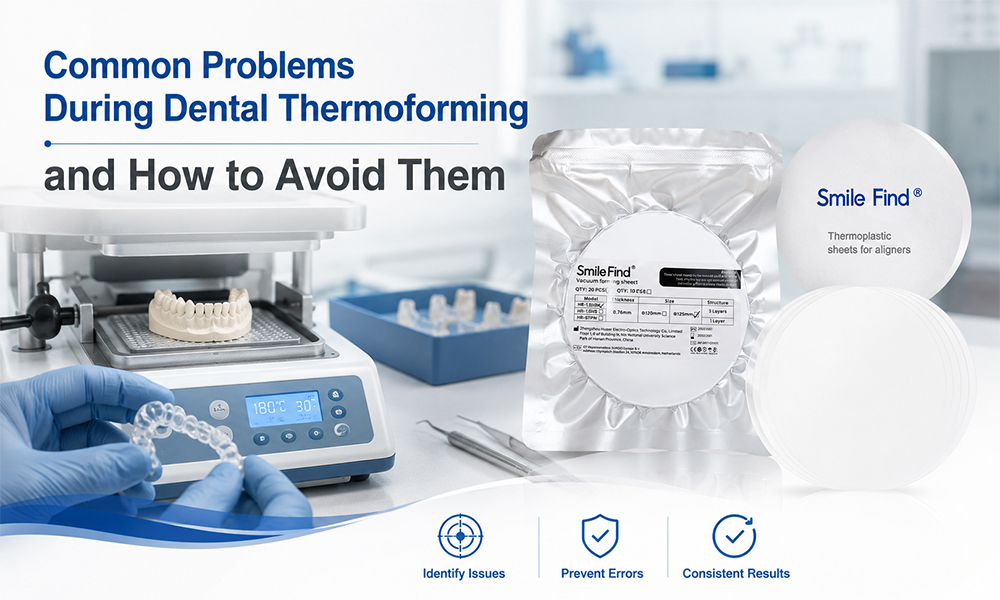
Common Problems During Dental Thermoforming and How to Avoid Them
Dental thermoforming is widely used in modern dentistry for manufacturing clear aligners, retainers, night guards, and other dental appliances. With the increasing demand for digital orthodontic solutions, dental labs rely on high-quality thermoforming sheets to achieve consistent results and improve production efficiency.
However, even experienced technicians may encounter various dental thermoforming problems during the forming process, including bubbles, cracking, uneven thickness, and edge deformation. These issues can affect appliance accuracy, aesthetics, and overall production efficiency.
In many cases, thermoforming failures are not only caused by the machine but also relate to material quality, storage conditions, heating parameters, and incorrect sheet selection.
This guide explains the most common dental thermoforming problems, their causes, and practical solutions to help dental labs achieve more stable and reliable thermoforming results.
Bubbles During Dental Thermoforming
One of the most common dental thermoforming problems is the appearance of bubbles inside the formed sheet. Bubbles can affect transparency, surface quality, and the final performance of dental appliances.
Common Symptoms
Dental labs may notice:
- Small bubbles appearing inside the material
- Cloudy or unclear appearance
- Reduced aesthetic quality of aligners or retainers
- Visible defects after forming
Main Causes of Bubbles
1. Moisture Absorption
Many dental thermoforming materials, especially PETG sheets, are sensitive to moisture. When sheets absorb excessive humidity during storage, water vapor may be released during heating, resulting in bubbles.
Improper storage conditions, such as high humidity environments or unsealed packaging, can increase the risk of moisture-related defects.
2. Excessive Heating Temperature
Overheating dental sheets can cause material degradation and gas release. When the temperature exceeds the recommended range, the sheet may lose its original optical properties and forming stability.
How to Prevent Bubbles
To reduce bubble formation:
- Store dental thermoforming sheets in a dry environment
- Keep unopened packages sealed until use
- Follow recommended heating parameters
- Avoid overheating during thermoforming
Proper material storage and controlled heating are essential for maintaining consistent forming quality.
Cracking After Dental Thermoforming
Cracking is another frequent issue that can lead to material waste and production delays. Cracks may appear during forming, trimming, or after the appliance is completed.
Common Symptoms
- Cracks around edges
- Fractures during trimming
- Brittle finished appliances
- Reduced durability
Why Does Thermoforming Sheet Crack?
1. Poor Material Quality
Low-quality sheets may have inconsistent molecular structures, resulting in poor flexibility and higher risk of cracking.
2. Incorrect Heating Process
Insufficient heating can prevent the material from stretching properly, while excessive heating may weaken the sheet structure.
Both situations can reduce forming performance.
3. Incorrect Sheet Thickness Selection
Different applications require different thicknesses. Using a sheet that is too thin or too thick for a specific application may affect flexibility and strength.
How to Avoid Cracking
Dental labs can improve forming results by:
- Selecting suitable sheet thickness
- Using high-quality PETG, TPU, or EVA materials
- Optimizing heating temperature and time
- Avoiding excessive stretching during forming
Uneven Thickness After Thermoforming
Uniform thickness is critical for producing accurate dental appliances. Uneven thickness after forming may affect comfort, strength, and clinical performance.
Common Causes
1. Uneven Heating
If the thermoforming machine does not heat the sheet evenly, some areas may become softer than others, resulting in inconsistent stretching.
2. Insufficient Vacuum Pressure
Poor vacuum performance may prevent the sheet from adapting closely to the dental model.
This can cause:
- Thin areas
- Poor adaptation
- Inconsistent appliance thickness
3. Incorrect Sheet Selection
Choosing the wrong thickness for the application can also create problems.
Typical applications:
| Sheet Thickness | Common Applications |
|---|---|
| 0.8mm | Thin retainers and orthodontic applications |
| 1.0mm | General clear aligner production |
| 1.5mm | Stronger dental appliances |
Selecting the correct thickness helps maintain both comfort and durability.
Edge Deformation After Thermoforming
Edge deformation is a common quality issue, especially during clear aligner production.
Common Symptoms
- Uneven edges
- Warped margins
- Poor trimming results
- Reduced appliance fit
Main Causes
1. Excessive Heating
Too much heat can make the material overly soft, causing uncontrolled stretching and deformation.
2. Improper Cooling
Removing the formed sheet too quickly before sufficient cooling may affect dimensional stability.
3. Incorrect Machine Settings
Vacuum pressure, heating time, and forming temperature must be adjusted according to different materials.
Solutions
To minimize edge deformation:
- Optimize thermoforming parameters
- Allow sufficient cooling time
- Use materials with stable forming performance
- Maintain consistent machine calibration
Material Selection Problems: PETG vs TPU vs EVA Thermoforming Sheets
Choosing the right material is one of the most important factors in avoiding dental thermoforming problems.
Different materials have different characteristics.
| Material | Advantages | Common Considerations |
|---|---|---|
| PETG | Excellent transparency, easy forming, cost-effective | Requires proper moisture control |
| TPU | High elasticity and flexibility | Needs accurate forming parameters |
| EVA | Soft and comfortable | Lower rigidity compared with PETG and TPU |
For dental labs, the ideal material depends on:
- Appliance type
- Required flexibility
- Strength requirements
- Production process
Selecting a reliable dental thermoforming sheet supplier can help ensure stable material performance.
Proper Storage to Prevent Thermoforming Failures
Material storage is often overlooked but plays an important role in thermoforming quality.
Even high-quality dental sheets may experience performance issues if stored incorrectly.
Recommended Storage Conditions
For most dental thermoforming sheets:
- Temperature: 15-25°C
- Humidity: 40-60%
- Avoid direct sunlight
- Keep original packaging sealed
Poor Storage May Cause:
- Yellowing
- Brittleness
- Reduced transparency
- Increased bubble formation
Proper inventory management and storage conditions help maintain consistent product quality.
How to Choose Reliable Dental Vacuum Forming Sheets
When purchasing dental thermoforming sheets, dental labs and distributors should evaluate more than just price.
Important factors include:
Material Quality
Reliable suppliers should provide consistent:
- PETG quality
- TPU flexibility
- EVA performance
Thickness Accuracy
Precise thickness control ensures stable thermoforming results.
Transparency and Appearance
High optical clarity is essential for aesthetic orthodontic appliances.
Batch Consistency
For large-volume production, consistent performance between batches is critical.
OEM Capability
For distributors and dental brands, OEM customization, packaging options, and flexible order quantities can provide additional business advantages.
Conclusion
Dental thermoforming problems such as bubbles, cracking, uneven thickness, and edge deformation can significantly impact dental appliance production.
Most issues can be reduced by focusing on three key areas:
- Choosing suitable thermoforming sheet materials
- Maintaining proper storage conditions
- Optimizing thermoforming parameters
High-quality dental vacuum forming sheets provide better forming stability, improved transparency, and consistent performance for dental laboratories.
SmileFind® offers reliable PETG, TPU, and EVA thermoforming sheet solutions designed for clear aligner production, retainers, and other dental applications. Contact us to explore customized solutions for your dental material requirements.
FAQ
1. Why do bubbles appear during dental thermoforming?
Bubbles are usually caused by moisture absorption, excessive heating, or improper storage. Keeping dental thermoforming sheets dry and following recommended forming parameters can help prevent this issue.
2. Why do dental thermoforming sheets crack after forming?
Cracking may result from poor material quality, incorrect heating settings, or unsuitable sheet thickness. Choosing reliable PETG, TPU, or EVA sheets can improve forming stability.
3. How can I avoid uneven thickness after thermoforming?
Uneven thickness is often caused by inconsistent heating, insufficient vacuum pressure, or incorrect material selection. Proper machine settings and suitable sheet thickness can improve results.
4. How should dental thermoforming sheets be stored?
Dental thermoforming sheets should be stored in a dry environment at 15-25°C with 40-60% humidity. Proper storage helps maintain transparency and forming performance.
5. How do I choose the right dental thermoforming sheet supplier?
A reliable supplier should provide consistent material quality, accurate thickness control, stable production capacity, OEM support, and reliable after-sales service.
Inquire Us Now
We will Get Back to You soon