
Light Body vs Heavy Body Impression Kits: Choosing the Right Combination for Lab Efficiency
Take the same impression procedure, on two different days, and you can end up with two very different results. One model comes back with a crisp, well-defined margin. The other shows a blurred edge, a small void near the preparation, or a tray that felt unstable the moment it was removed from the mouth.
The difference usually isn’t technique. It’s viscosity.
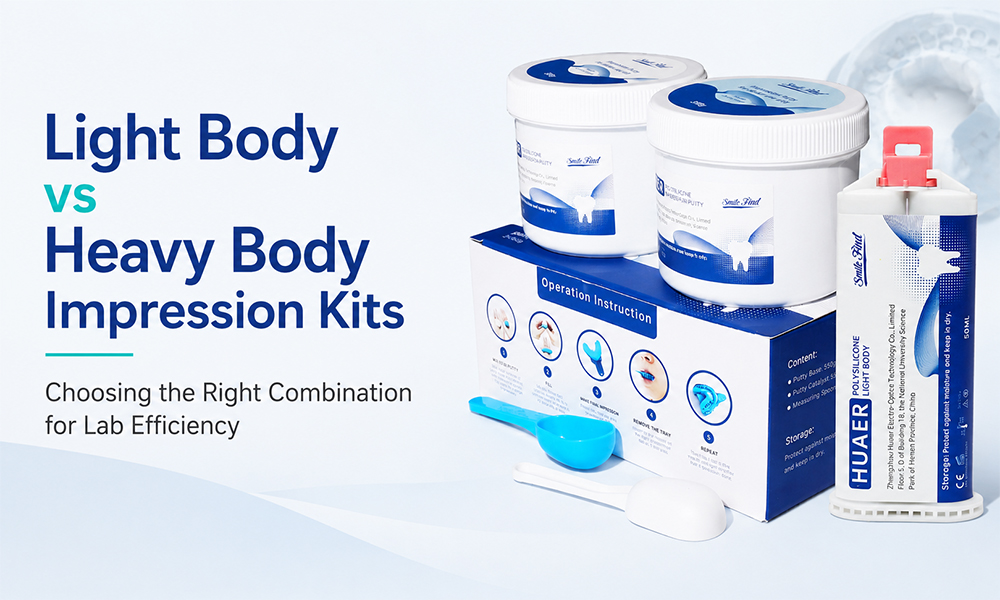
Impression materials aren’t a single, one-size-fits-all product — they’re a system of materials with different jobs. At SmileFind®, our impression material line is built around this exact principle: Putty, Light Body, Regular Body, and Heavy Body cartridges, each formulated to do a specific part of the job, available in 2+1, 3+1, and 4+2 kit configurations. Understanding what light body and heavy body impression material actually do, and why they’re meant to work together, makes the difference between a clean model on the first attempt and a case that has to be redone. This guide breaks down the difference, explains why the combination matters more than either material alone, and helps you match kit configuration to your actual case volume.
What's the Difference Between Light Body and Heavy Body Impression Material?
Heavy body material — often supplied as a putty — is the structural layer. It has high viscosity and high tear strength, which means it holds its shape once loaded into a tray and resists distortion when the impression is removed from the mouth. Its job is stability: providing a rigid, dimensionally accurate base that the rest of the impression relies on.
Light body material is the detail layer. It has much lower viscosity, which allows it to flow easily across the surface of a prepared tooth, wetting fine anatomical detail before it sets. Where heavy body material is too thick to reach into narrow spaces or subgingival margins, light body material moves into them with minimal resistance.
The distinction matters most in precision cases. For implant impressions in particular, capturing the exact position and angulation of the implant platform requires the kind of fine detail reproduction that only a lower-viscosity material can reliably achieve — which is why heavy body putty is typically paired with light body material rather than used on its own for anything beyond a simple preliminary impression.
SmileFind®’s Heavy Body formula is built specifically for this role: high viscosity with advanced thixotropic characteristics, designed to hold its shape under pressure while still allowing precise implant-level detail once paired with a light body layer.
Why the Combination Matters More Than Either Material Alone
This is where the “double mix” technique comes in — and it’s the reason most professional impression kits are sold as a putty-and-light-body pairing rather than a single material.
The process is straightforward: heavy body putty is loaded into the tray first, providing the overall shape and structural support. Light body material is then applied directly to the prepared tooth surface, where it flows into fine detail before the tray is seated. As both materials set together, they bond into a single, unified impression — the heavy body holding everything rigid, the light body preserving the detail at the margin.
Skip one half of this pairing, and predictable problems follow.
Heavy body alone captures the general shape of the arch, but it’s too viscous to reach fine detail. Margins come out rounded or incomplete, especially in areas with limited access or moisture. This is one of the most common causes of a remake — not because the material failed, but because it was never designed to do that job by itself.
Light body alone, on the other hand, has the opposite problem. It captures detail beautifully, but without the structural support of a heavy body backing, the impression lacks rigidity. It’s more prone to distortion during removal, during shipping to the lab, or simply while it sits waiting to be poured.
Used together, each material compensates for what the other can’t do. That’s not a marketing distinction — it’s the actual mechanical reason the combination exists.
Matching Your Kit Configuration to Your Case Volume
Beyond the putty-to-light-body ratio, the practical question most labs and clinics face is simpler: how much of each material do you actually need to keep up with your caseload? This is where kit configuration comes in.
SmileFind® packages its Putty and Light Body materials into three standard kit configurations, so practices can match their impression material supply to actual case volume rather than defaulting to a single fixed ratio:
| Kit Configuration | Best Suited For |
|---|---|
| SmileFind® 2+1 Kit (2 putty + 1 light body) | Smaller practices with lower case volume, or clinics standardizing their impression material supply for the first time |
| SmileFind® 3+1 Kit (3 putty + 1 light body) | Practices with a steady mix of single-unit and multi-unit cases — a balanced, mid-volume configuration |
| SmileFind® 4+2 Kit (4 putty + 2 light body) | High-volume labs and clinics handling frequent multi-unit restorations, implant cases, or full-arch impressions |
The logic behind these ratios is simple: as case volume grows, so does the demand on both materials — but not always in the same proportion. Labs running more implant and precision restorative work often need a higher share of light body material relative to putty, since that’s the material doing the fine detail work. Matching kit configuration to actual case mix, rather than defaulting to the largest kit available, helps avoid both running short mid-month and letting unused material sit past its useful shelf life.
Special Cases: When You Need Bite Registration Material Too
Light body and heavy body cover the impression itself, but occlusal relationships are a separate consideration. Bite registration material is formulated differently — designed to set quickly and hold enough rigidity to accurately capture how the upper and lower arches meet, which is essential for CO/CR (centric occlusion/centric relation) record-taking.
Unlike putty or light body, bite registration material prioritizes fast setting time and dimensional stability over flow characteristics, since its job isn’t to capture surface detail but to freeze a precise spatial relationship between arches. For labs working with CAD/CAM digital workflows, a compatible bite registration material also needs to scan cleanly, without distortion that could throw off a digital model.
If your kit inventory only includes putty and light body, it’s worth checking whether your current workflow is missing this third material — particularly for any case involving crown and bridge work where an accurate bite record directly affects the final fit. SmileFind®’s Silicone Bite Registration Material is formulated for exactly this: a fast, thixotropic set that captures occlusal accuracy in seconds while remaining compatible with CAD/CAM scanning.
How to Reduce Remakes with the Right Combination
Most remakes traced back to impression material aren’t caused by a defective batch — they’re caused by a mismatch between the material combination and the case at hand. A few patterns are worth watching for:
- If margins are consistently coming out incomplete or rounded, especially around implants or subgingival preparations, the issue is often too little light body relative to the complexity of the case — not a problem with the putty.
- If impressions are arriving at the lab distorted or showing signs of movement after they were taken, that usually points to insufficient heavy body support, rather than an issue with the light body detail layer.
- If case volume has grown but kit configuration hasn’t changed, practices sometimes stretch a 2+1 kit across a caseload that really calls for a 3+1 or 4+2 — leading to inconsistent mixing ratios as staff try to make a smaller kit cover more cases than it was designed for.
Reviewing which of these patterns shows up most often is usually a faster way to reduce remakes than switching brands entirely — the fix is frequently in the ratio, not the material itself.
FAQ
What’s the difference between putty and heavy body impression material? In most professional kits, “putty” and “heavy body” refer to the same category of high-viscosity material. It provides structural support and tray stability, and is typically hand-mixed or supplied in a jar rather than a cartridge.
Can I use light body material alone without heavy body? It’s possible for very simple, single-tooth impressions, but it’s not recommended for most clinical cases. Without heavy body support, light body material lacks the rigidity to resist distortion during removal and transport, which increases the risk of a remake.
How do I choose between a 2+1, 3+1, or 4+2 impression kit? Match the configuration to your case volume and case mix. Lower-volume practices generally do well with a 2+1 kit, while labs handling frequent multi-unit or implant cases typically need the higher light body ratio found in a 3+1 or 4+2 configuration.
Is light body material suitable for implant impressions? Yes — light body material’s low viscosity and ability to flow into fine detail make it well suited for capturing the precise position of an implant platform, typically used in combination with heavy body putty for structural support.
How long do SmileFind impression materials stay dimensionally stable after setting? SmileFind® impression materials are formulated to remain dimensionally stable for up to 28 days after setting, allowing for flexible scheduling between taking the impression and pouring the model.
Conclusion
Light body and heavy body impression materials aren’t competing options — they’re two halves of the same system, each compensating for what the other can’t do on its own. Getting the combination right, and matching kit configuration to actual case volume, is often a more effective way to reduce remakes and improve lab efficiency than switching materials altogether.
SmileFind® manufactures FDA and ISO 13485-certified impression materials for dental clinics, laboratories, and distributors worldwide, available in Putty, Light Body, Regular Body, and Heavy Body cartridges, as well as 2+1, 3+1, and 4+2 kit configurations. Explore our impression material collection or request a free sample kit to find the right combination for your workflow.
Inquire Us Now
We will Get Back to You soon