
How to Store Dental Aligner Sheets: Temperature, Humidity & Shelf Life Guide
Dental aligner sheets are one of the most important materials used in modern orthodontics. Whether you’re manufacturing clear aligners in a dental laboratory, purchasing thermoforming materials for an orthodontic clinic, or distributing dental consumables worldwide, the quality of every aligner starts long before it reaches the thermoforming machine.
However, many laboratories and clinics focus heavily on selecting premium PETG or TPU aligner sheets while overlooking an equally critical factor—proper storage.
Improper storage conditions can cause dental aligner sheets to yellow, become brittle, absorb moisture, or lose their original mechanical properties. These seemingly small changes often lead to bubbles during thermoforming, inconsistent forming accuracy, reduced transparency, and ultimately wasted materials and higher production costs.
In other words, you may purchase excellent aligner sheets, but your storage method determines whether they are still excellent when they reach the thermoforming machine.
This guide explains the ideal storage temperature, humidity, light exposure, shelf life, and inventory management practices for dental aligner sheets. Whether you work in a high-volume dental laboratory, orthodontic clinic, or distribution business, these recommendations will help you protect your investment and achieve consistently high-quality thermoforming results.
Why Storage Conditions Matter for Aligner Sheets
Dental aligner sheets may look like simple transparent plastic discs, but they are actually precision-engineered thermoplastic polymers designed to deliver consistent thermoforming performance.
Materials such as PETG, TPU, EVA, and multilayer composites are carefully manufactured to achieve specific characteristics, including:
- High optical transparency
- Excellent dimensional stability
- Controlled flexibility
- Uniform thickness
- Predictable thermoforming behavior
These properties are achieved through carefully controlled manufacturing processes. However, once the sheets leave the factory, environmental conditions begin to influence their performance.
Temperature, humidity, ultraviolet (UV) exposure, and improper storage can gradually alter the molecular structure of thermoplastic materials. Although these changes are often invisible to the naked eye, they become obvious during thermoforming.
Moisture Absorption Can Cause Bubbles
One of the most common production problems is moisture absorption.
PETG, in particular, is a hygroscopic material, meaning it naturally absorbs moisture from the surrounding air. When a moisture-containing sheet is heated during thermoforming, the absorbed water rapidly turns into steam.
As steam escapes from the material, it creates tiny bubbles within the aligner, resulting in:
- Reduced transparency
- Surface imperfections
- Lower aesthetic quality
- Higher rejection rates
For laboratories producing hundreds of aligners every week, even a small increase in defective products can significantly affect productivity and profitability.
High Temperatures Can Reduce Forming Accuracy
Excessive heat is another common issue.
When aligner sheets are stored in environments above the recommended temperature for long periods, residual internal stress within the material may gradually release.
Although the sheet may still appear flat, its thermoforming behavior changes.
Possible consequences include:
- Uneven material flow
- Reduced forming precision
- Poor adaptation to dental models
- Increased dimensional variation
For orthodontic appliances requiring micron-level accuracy, these changes can compromise the final fit of the aligner.
Proper Packaging Is Only the First Step
At SmileFind®, our PETG and TPU Dental Thermoforming Sheets are individually sealed to protect against moisture, dust, and contamination during transportation.
However, factory packaging alone cannot guarantee long-term material performance.
Once the original package has been opened, proper storage becomes equally important. Following the correct storage practices helps preserve the transparency, flexibility, and thermoforming consistency that laboratories expect from premium orthodontic materials.
Temperature Requirements
Temperature is one of the most important environmental factors affecting aligner sheet storage.
Although different materials have slightly different tolerances, maintaining a stable storage temperature significantly improves material consistency and extends shelf life.
Recommended Storage Temperature
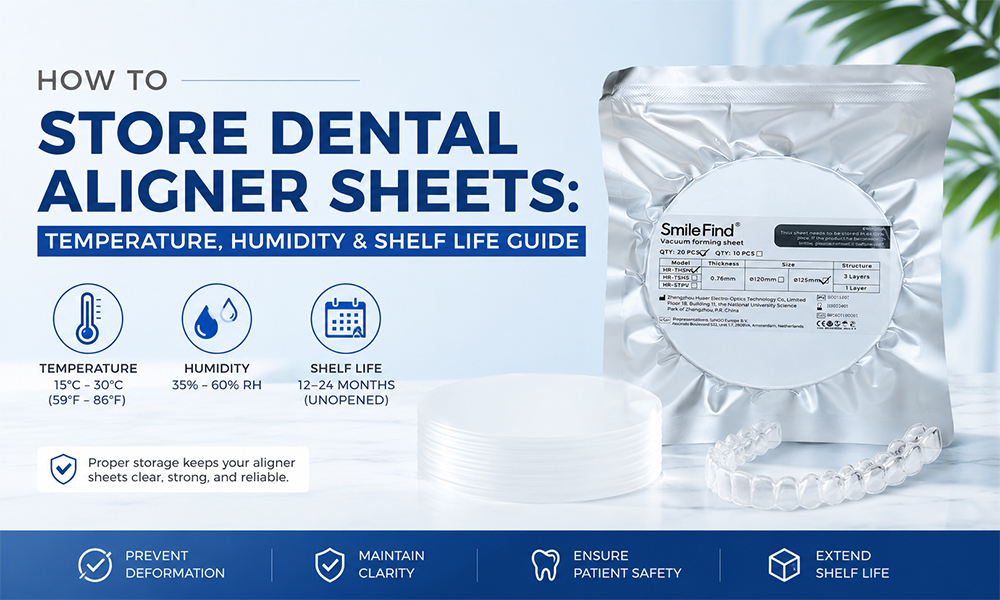
For most dental thermoforming sheets, the ideal storage temperature is:
15°C–25°C (59°F–77°F)
This temperature range helps preserve:
- Mechanical strength
- Dimensional stability
- Optical clarity
- Thermoforming consistency
- Long-term shelf life
Whenever possible, store aligner sheets in a climate-controlled room away from direct heat sources.
Temperature Recommendations for PETG Sheets
PETG remains the most widely used material for clear aligners because of its excellent transparency, strength, and thermoforming performance.
However, it is also one of the more temperature-sensitive materials.
For SmileFind® PETG Dental Thermoforming Sheets, prolonged exposure to temperatures above 30°C (86°F) may gradually lead to slight deformation, even if the change is not immediately visible.
To minimize risk, avoid storing PETG sheets:
- Near thermoforming machines
- Beside curing lights
- Next to heaters or radiators
- Under direct sunlight
- Inside poorly ventilated warehouses during summer
High temperatures can cause the material to soften slightly over time, reducing forming precision during production.
Avoid Extremely Low Temperatures
Cold storage is not always beneficial.
Temperatures below 5°C (41°F) can make PETG more brittle during handling.
Although the sheet may still be usable, brittleness increases the risk of edge cracking, handling damage, or inconsistent thermoforming behavior.
For best results, PETG sheets should always be stored at normal room temperature before production.
Temperature Recommendations for TPU Sheets
Compared with PETG, TPU aligner sheets generally offer greater flexibility and slightly better resistance to temperature fluctuations.
However, this does not mean TPU is immune to poor storage practices.
SmileFind® Single-Layer TPU Sheets and Multi-Layer TPU Sheets should also be stored within the recommended range of 15°C–25°C (59°F–77°F).
The most important consideration for TPU is avoiding sudden temperature changes.
For example:
- Removing sheets directly from a cold warehouse and immediately placing them into a thermoforming machine
- Moving inventory rapidly between air-conditioned storage and hot production environments
Rapid temperature changes can lead to condensation forming on the sheet surface, introducing unwanted moisture before thermoforming.
Allow Materials to Reach Room Temperature
If aligner sheets have been stored in a cold environment, allow them to acclimate at room temperature for approximately 30 minutes before use.
This simple step helps ensure:
- Stable thermoforming performance
- Consistent heating
- Reduced moisture condensation
- Improved dimensional accuracy
For high-volume laboratories, incorporating this acclimation step into the production workflow can significantly reduce forming defects and improve overall manufacturing consistency.
Humidity Requirements
Humidity is one of the most overlooked factors in dental thermoforming sheet storage, yet it directly affects material performance during vacuum forming and pressure forming processes.
Most dental-grade thermoplastic sheets such as PETG, TPU, and EVA are hygroscopic to different degrees. When exposed to high humidity environments, they can absorb moisture from the air, which leads to:
- Bubble formation during heating
- Uneven sheet softening
- Reduced transparency in aligner materials
- Internal stress cracking after forming
- Poor lamination with models or attachments
Recommended Humidity Range
For optimal performance, the recommended storage humidity is:
- Ideal range: 30% – 50% RH
- Maximum safe limit: ≤60% RH
- Critical risk zone: >65% RH
Practical Storage Recommendations
To maintain material stability:
- Use sealed aluminum foil packaging for long-term storage
- Add desiccant packs (silica gel) inside storage boxes
- Avoid placing materials near sterilization areas or autoclaves
- Do not store sheets in open lab environments overnight
SmileFind® Dental Thermoforming Sheets are packaged with moisture-resistant barrier film to minimize humidity absorption during transportation and storage, ensuring consistent forming performance even in high-humidity regions.
Light & UV Exposure
Dental thermoforming materials are sensitive not only to heat but also to long-term exposure to light—especially UV radiation.
UV exposure causes gradual polymer degradation, which leads to:
- Yellowing of transparent sheets
- Brittleness and micro-cracking
- Reduced elasticity in TPU-based materials
- Loss of optical clarity for aligner applications
Key Light Exposure Risks
| Exposure Type | Impact on Material |
|---|---|
| Direct sunlight | Rapid yellowing + structural weakening |
| UV sterilization lamps | Surface degradation over time |
| Fluorescent lab lighting (long-term) | Slow discoloration |
| LED ambient lighting | Minimal impact (safe for storage) |
Best Storage Practices
To minimize UV-related degradation:
- Store sheets in opaque or aluminum packaging
- Keep away from windows or direct sunlight
- Avoid UV sterilization zones for raw material storage
- Use closed cabinets or drawers in dental labs
SmileFind® PETG and TPU aligner sheets are manufactured with enhanced UV-stabilized polymer structures, improving resistance to discoloration during storage and clinical handling.
Shelf Life by Material
The shelf life of dental thermoforming sheets depends heavily on material type, packaging integrity, and storage conditions. Below is a practical reference table for clinical and laboratory use.
Standard Shelf Life Overview
| Material Type | Recommended Shelf Life | Storage Sensitivity | Key Notes |
|---|---|---|---|
| PETG Sheets | 24 – 36 months | Medium | Most stable for aligners, widely used |
| TPU Sheets | 18 – 24 months | High | Sensitive to humidity, needs sealed storage |
| EVA Sheets | 12 – 18 months | Very High | Prone to aging and deformation |
| Polycarbonate (PC) | 24 months | Medium | High rigidity, less used for aligners |
| Multi-layer Hybrid Sheets | 18 – 30 months | Medium-High | Depends on inner TPU/PETG layers |
Important Shelf Life Notes
- Shelf life assumes sealed, original packaging
- Once opened, exposure time should be minimized (<30 days recommended)
- High temperature + humidity environments significantly reduce usable lifespan
- Material performance degradation often appears before visible expiration date
Clinical Insight
In real-world dental lab usage, the first-in-first-out (FIFO) inventory strategy is strongly recommended to avoid hidden material aging issues that affect aligner fit accuracy.
SmileFind® Dental Vacuum Forming Sheets are designed with multi-layer moisture-barrier packaging to extend real-world usability, especially for international distributors and high-volume dental laboratories.
Conclusion
Proper storage is not just about extending shelf life—it directly affects forming accuracy, aligner fit, and overall clinical outcomes.
For dental laboratories and distributors, choosing a stable supply chain and professionally packaged materials is far more important than focusing solely on unit price.
SmileFind® is committed to providing consistent, traceable, and high-stability thermoforming sheet solutions for global dental professionals—ensuring every sheet performs at its best from storage to clinical use.
Inquire Us Now
We will Get Back to You soon