
The Future of Dental 3D Printing and Aligner Production: How Digital Dentistry Is Transforming Orthodontics
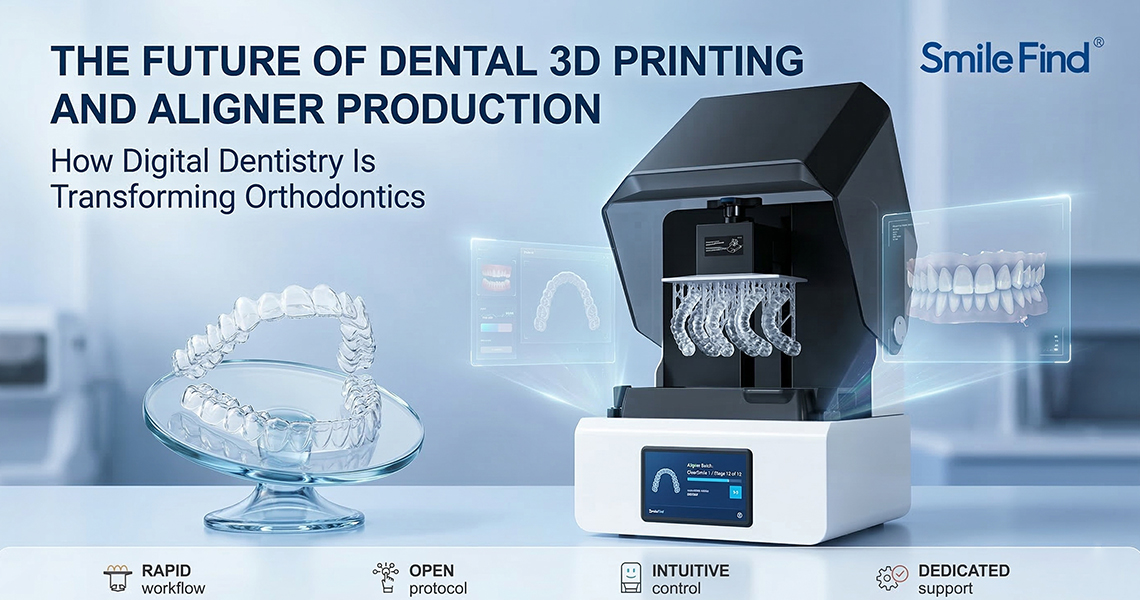
Over the past decade, digital dentistry has rapidly transformed the way dental laboratories and orthodontic clinics operate. Traditional workflows that once relied on physical impressions, manual model fabrication, and outsourced production are being replaced by fully digital systems.
At the centre of this transformation is dental 3D printing. With the rise of clear aligner treatments, dental professionals are increasingly adopting digital workflows to improve efficiency, accuracy, and scalability.
Today, aligner production often begins with a digital scan, followed by treatment planning software, 3D printed models, and thermoforming processes. This streamlined approach allows dental labs and orthodontic clinics to produce high-quality aligners faster and more consistently than ever before.
As demand for clear aligners continues to grow globally, dental 3D printing is becoming an essential tool for modern orthodontic production.
How Dental 3D Printing Is Revolutionising Aligner Manufacturing
Clear aligner manufacturing relies heavily on precise dental models. These models are used to form each stage of the aligner treatment process. Traditionally, producing these models involved labour-intensive steps and longer turnaround times.
Dental 3D printing has simplified and accelerated this workflow.
A typical digital aligner production process includes:
Digital intraoral scanning of the patient’s teeth
Orthodontic treatment planning using specialised software
3D printing of sequential dental models
Thermoforming aligners over each printed model
Finishing, trimming, and packaging
By replacing manual fabrication with automated digital processes, dental labs can produce highly accurate models within hours instead of days.
This level of efficiency is particularly important as the global clear aligner market continues to expand. Clinics and labs now require faster turnaround times while maintaining precise treatment outcomes.
Key Advantages of Dental 3D Printing for Dental Labs
Dental laboratories around the world are adopting 3D printing technology because it offers several clear advantages for aligner production.
Faster Production Cycles
3D printers can produce multiple dental models simultaneously, significantly reducing production time. Instead of waiting days for outsourced models, labs can complete the entire workflow in-house.
High Precision and Consistency
Dental aligners require precise incremental movements. High-resolution dental printers can produce models with excellent accuracy, ensuring predictable orthodontic results.
Reduced Operational Costs
By bringing production in-house, dental labs reduce outsourcing costs and improve control over their workflow. Over time, this can lead to significant cost savings.
Scalable Manufacturing
As aligner demand grows, labs can simply scale production by printing multiple models in batches. This makes dental 3D printing ideal for both small labs and large aligner manufacturers.
The Growing Demand for In-House Aligner Production
More orthodontic clinics and dental labs are choosing to produce aligners internally rather than relying entirely on external suppliers.
Several factors are driving this trend:
Faster patient turnaround times
Lower long-term production costs
Greater control over treatment planning
Ability to offer customised orthodontic solutions
In-house aligner production also allows clinics to expand their service offerings and remain competitive in an increasingly digital dental market.
To support this shift, reliable and efficient dental 3D printing systems have become essential components of the modern dental laboratory.
Why Choosing the Right Dental 3D Printer Matters
Not all 3D printers are suitable for dental applications. When selecting a printer for aligner production, dental labs must consider several important factors.
Printing Accuracy
Orthodontic models require extremely high precision. Even small deviations can affect aligner fit and treatment effectiveness.
Printing Speed
Efficient printing speed allows labs to produce multiple models per day, improving productivity and reducing patient wait times.
Material Compatibility
Dental printers must support specialised dental resins designed for orthodontic and dental model production.
Reliability for Continuous Production
For labs producing large volumes of aligner models, machine stability and consistent performance are critical.
Choosing a dedicated dental 3D printer designed specifically for dental applications ensures that laboratories can maintain both accuracy and productivity.
A Reliable Solution for Dental 3D Printing Workflows
For dental labs and orthodontic clinics looking to optimise their digital workflow, investing in a professional dental 3D printer can significantly improve aligner production efficiency.
A specialised dental 3D printing system allows laboratories to produce high-precision orthodontic models quickly and reliably. This makes it easier to manage large volumes of aligner cases while maintaining consistent quality.
If you are exploring solutions for dental model printing and aligner workflows, you can learn more about this technology here:
This type of system is designed specifically for dental applications, making it suitable for orthodontic models, dental labs, and digital dentistry workflows.
Future Trends in Dental 3D Printing
As digital dentistry continues to evolve, dental 3D printing technology is expected to become even more advanced.
Several trends are shaping the future of the industry.
AI-Driven Treatment Planning
Artificial intelligence is increasingly being integrated into orthodontic treatment planning software, improving case prediction and treatment accuracy.
Fully Digital Dental Laboratories
Many labs are moving toward fully digital workflows, from scanning and design to printing and aligner production.
Faster Resin Printing Technologies
New resin printing technologies are improving speed and resolution, allowing labs to produce models more efficiently.
Mass Customisation of Orthodontic Treatments
Digital workflows allow every aligner to be customised for individual patients, enabling highly personalised orthodontic care.
These advancements will continue to strengthen the role of dental 3D printing as the backbone of modern orthodontics.
Conclusion
Dental 3D printing is rapidly transforming the way aligners are designed, produced, and delivered. By enabling faster production, higher precision, and scalable workflows, this technology is helping dental labs and orthodontic clinics meet the growing global demand for clear aligners.
As digital dentistry continues to evolve, adopting reliable 3D printing solutions will be essential for labs that want to remain competitive.
For dental professionals exploring digital workflows, investing in a dedicated dental 3D printer can significantly improve aligner production efficiency and support the future of orthodontic manufacturing.
FAQ
What is dental 3D printing used for?
Dental 3D printing is used to produce a wide range of dental models and devices, including orthodontic models, surgical guides, retainers, dentures, and clear aligner models.
How does 3D printing help in aligner production?
3D printing allows dental labs to quickly produce precise dental models that are used to thermoform clear aligners. Each printed model represents a specific stage in the orthodontic treatment plan.
Can dental clinics produce aligners in-house?
Yes. Many clinics and dental laboratories now produce aligners internally using digital workflows that include intraoral scanners, treatment planning software, and dental 3D printers.
What type of 3D printer is best for dental models?
Dental labs typically use high-resolution resin 3D printers designed specifically for dental applications. These printers provide the precision and consistency required for orthodontic models.
Related Blog
Inquire Us Now
We will Get Back to You soon