
The Ultimate Guide to Dental 3D Printers in 2025
Dental 3D Printing is revolutionizing modern dentistry by offering faster, more precise, and cost-effective solutions for clinics and dental labs. From creating accurate dental models and surgical guides to producing crowns, bridges, and aligners, 3D printing technology enables customized treatment with exceptional efficiency. As the demand for digital dentistry grows, dental 3D printing has become an essential tool for improving patient outcomes and streamlining clinical workflows.
The Digital Revolution in Your Dental Practice
Dental 3D printing is the centerpiece of the modern digital dental practice, a revolutionary technology that brings precision, speed, and efficiency to the forefront of patient care. Step into the future of dentistry, where patient satisfaction and streamlined workflows are daily realities. For years, the dental industry has been moving towards a fully digital process, and in-house 3D printing is the key that unlocks its ultimate potential.
So, what exactly is a dental 3D printer? In simple terms, it’s a device that builds a physical, three-dimensional object layer-by-layer from a digital design file. It takes the data from an intraoral scan or a CBCT scan and turns it into a tangible, highly accurate model, surgical guide, or restoration right in your office.
This technology matters now more than ever because it closes the loop on the digital workflow. It eliminates the need for messy physical impressions, costly shipping to outside labs, and long, unpredictable wait times. This article is your complete guide to understanding the profound benefits of incorporating a dental 3D printer into your practice, the vast range of applications it unlocks, and the crucial factors to consider when choosing the right printer for your needs.
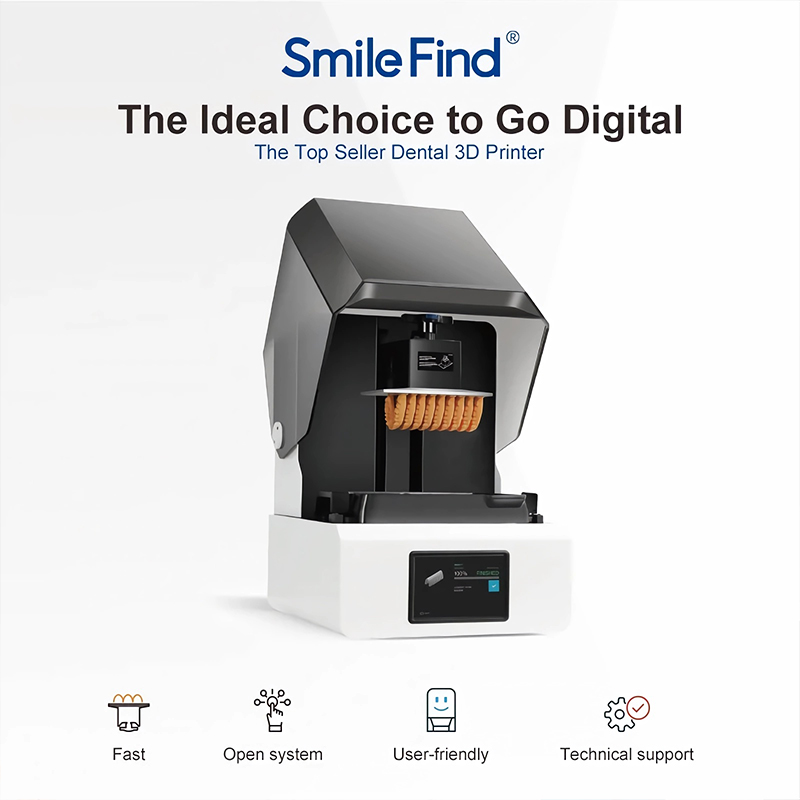
Why Your Practice Needs a Dental 3D Printer
Transforming Patient Care and Your Bottom Line
Adopting a dental 3D printer is more than just a technology upgrade; it’s a strategic investment that delivers tangible returns across every facet of your practice. From the quality of your clinical work to your financial health, the benefits are clear and compelling.
Unmatched Precision & Accuracy Traditional manual methods are prone to human error and material distortion. A dental 3D printer, however, operates with microscopic precision, consistently producing high-fidelity results that are perfectly faithful to your digital design. This means perfectly fitting crowns, incredibly accurate surgical guides, and models that reduce the need for adjustments, saving valuable chair time and ensuring superior clinical outcomes.
Drastic Increase in Speed & Efficiency Imagine turning a complex case around in hours instead of weeks. With an in-house dental 3D printer, the workflow is dramatically accelerated. You can go from an intraoral scan to a finished surgical guide or a set of aligner models on the same day. This empowers you to offer same-day dentistry for many applications, a powerful competitive advantage that modern patients value highly.
Significant Cost Reduction Outsourcing to dental labs represents a major, recurring expense. By bringing this production in-house, you gain full control over your costs and timelines. A dental 3D printer allows you to cut down on expensive outsourcing fees, eliminate shipping costs, and optimize your material usage to minimize waste. Over time, the printer doesn’t just pay for itself—it becomes a new source of profitability.
Superior Patient Experience Ultimately, the goal is always to provide the best possible care for your patients. 3D printing allows you to offer highly customized, perfectly fitting appliances that are more comfortable and effective. The faster turnaround times mean patients can start their treatments sooner and finish them faster, leading to higher satisfaction, better reviews, and more referrals.
A World of Possibilities: Key Applications of Dental 3D Printing
What Exactly Can You Create?
A dental 3D printer is an incredibly versatile tool that opens up a world of in-house production capabilities. Here are just a few of the key applications that can be integrated into your practice almost immediately:
Surgical Guides: Print biocompatible, transparent guides for perfectly angled and positioned implant placement, increasing safety and predictability.
Dental Models: Create highly accurate study, orthodontic, and diagnostic models directly from digital scans, eliminating the need for stone models.
Clear Aligners & Retainers: Produce models for in-house clear aligner fabrication, allowing you to start orthodontic cases faster and manage the entire process.
Custom Trays: Fabricate perfectly fitting custom impression trays for complex cases, ensuring the highest quality impressions.
Crowns & Bridges: Use biocompatible resins to print durable temporary crowns and bridges chairside. With advancing materials, permanent restorations are also becoming a reality.
Dentures & Digital Frameworks: Print highly accurate and customizable denture bases, try-ins, and frameworks for a better fit and faster workflow.
Night Guards & Splints: Offer patients durable, biocompatible, and comfortable solutions for bruxism and other TMJ disorders, printed right in your office.
The Buyer's Guide: How to Choose the Right Dental 3D Printer
Navigating Your Investment: 7 Key Factors to Consider
Selecting your first or next dental 3D printer is a critical decision. The market is filled with options, but focusing on these seven key factors will help you find the perfect fit for your practice’s specific needs and goals.
Printing Technology (SLA vs. DLP vs. LCD): While all three technologies use light to cure liquid resin, DLP and LCD are generally preferred for dental applications. They cure an entire layer at once, offering a significant speed advantage over SLA (which uses a laser to trace each layer) without sacrificing accuracy.
Accuracy & Resolution: This is measured in microns (µm) and determines the level of detail the printer can produce. For applications like crowns, bridges, and surgical guides, you need high accuracy (typically 50 microns or less) to ensure a perfect fit. For dental models, slightly lower resolution may be acceptable.
The Material Ecosystem (Resins): The printer is only as good as the materials it can use. Ensure the printer is compatible with a wide range of biocompatible, FDA or CE-approved dental resins. Also, consider if the system is “open” (allowing third-party resins) or “closed” (restricting you to the manufacturer’s materials), as this impacts long-term costs and flexibility.
Build Volume & Printer Footprint: The build volume dictates how many items you can print in a single run. A larger platform is more efficient for high-volume tasks like printing multiple aligner models overnight. Also, consider the physical size of the printer and whether it will fit comfortably in your office or lab space.
Software & Workflow Integration: The printer’s software should be intuitive and user-friendly. Most importantly, it must integrate seamlessly with your existing digital ecosystem, including your intraoral scanners and CAD design software, to ensure a smooth, frustration-free workflow.
The Full Workflow: Post-Processing: Printing is only the first step. After a part is printed, it must be washed in a solvent (like isopropyl alcohol) to remove excess uncured resin and then cured with UV light to achieve its final strength and biocompatibility. Look for a complete system that includes a dedicated wash and cure station for a streamlined and efficient process.
Support, Training, and Warranty: A reliable partner is just as important as the technology itself. Choose a vendor that offers comprehensive installation, hands-on training for your team, and responsive technical support. A solid warranty provides peace of mind for your investment.
The Future is Now: What's Next in Dental 3D Printing?
Emerging Trends to Watch
The field of dental 3D printing is evolving at a breathtaking pace. Keep an eye on these exciting trends that will continue to shape the future of digital dentistry:
New Permanent Materials: The development of stronger, more aesthetic, and more durable resins will soon make 3D printing the standard for permanent crowns, inlays, and onlays.
AI-Powered Software: The next generation of software will use artificial intelligence to automate tooth setup for aligners, detect potential errors in designs, and further simplify the entire workflow.
Faster Speeds & Larger Platforms: Printing technology will continue to get faster, enabling true chairside production for even more complex restorations, while larger build platforms will increase the throughput for labs and large clinics.
Complete Digital Ecosystem Integration: Expect to see even tighter integration between scanners, software, printers, and mills, creating a fully connected and automated chairside ecosystem.
Conclusion: Take Control of Your Digital Destiny
A dental 3D printer is no longer a luxury for high-tech practices; it is a foundational, accessible technology that improves precision, boosts efficiency, and drives profitability. It puts you in complete control of your production workflow, reduces your reliance on external labs, and elevates the standard of care you can offer your patients. Making this investment is a definitive step towards future-proofing your practice and securing your place at the forefront of modern dentistry.
Ready to revolutionize your practice? Contact our dental technology experts today for a personalized consultation and discover the perfect 3D printing solution for your needs.
Related Blog
Inquire Us Now
We will Get Back to You soon