
What Affects The Transparency Of Aligner Materials?
Ever looked at a clear aligner and thought,
“Why does this one look perfectly clear while another has that weird cloudy tint?”
That difference?
It’s all about the aligner materials.
If you’re running a dental lab or manufacturing brand, you already know:
Transparency sells.
Your clients want aligners that look invisible, fit well, and don’t lose clarity after forming.
So, let’s break down what actually affects how clear your aligner materials stay — and how to make sure your products always look top-tier.
What Exactly Are Aligner Materials?
Most aligners are made from thermoplastic sheets — materials like PETG, TPU, or polycarbonate.
These sheets are heated, formed, and trimmed into shape to create clear aligners.
Simple in theory.
But the quality of the material? That’s what separates an average aligner from a premium one.
At SmileFind®, we’ve tested more sheet formulas than we can count.
And here’s what we’ve learned about what kills — or keeps — transparency.
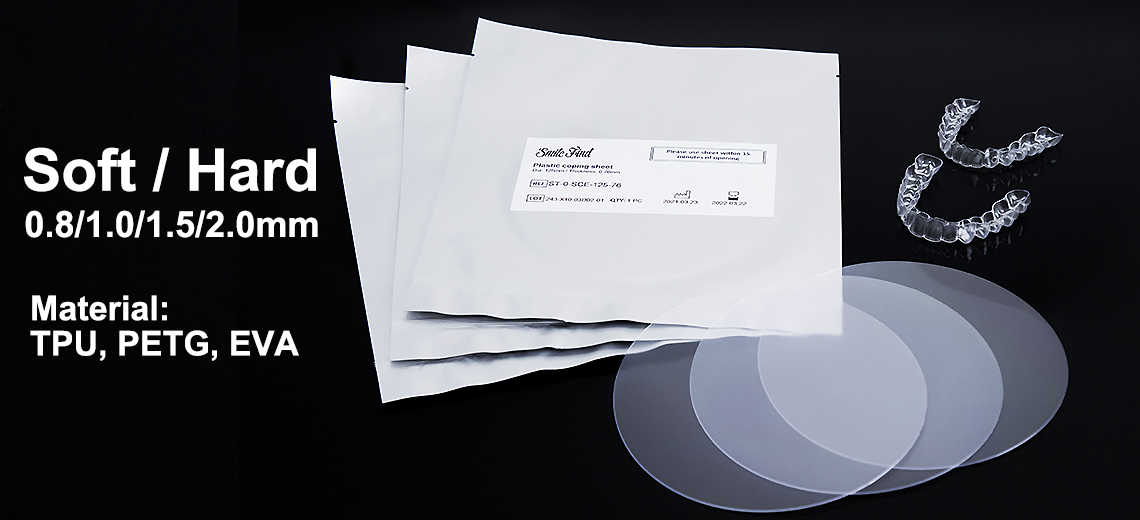
What Exactly Are Dental Impression Kits?
1. Raw Material Purity
You can’t polish a bad polymer.
If the base resin isn’t pure, you’ll get haziness right out of the gate.
Cheap or recycled materials often have inconsistent polymer chains that scatter light instead of letting it pass cleanly.
We use medical-grade PETG — the stuff made for dental precision, not packaging film.
That’s how we keep every sheet crystal-clear before it even hits your forming machine.
2. Moisture & Storage
PETG is a bit like a sponge — it absorbs moisture fast.
If your sheets aren’t stored in a dry environment or sealed pack, you’ll see tiny bubbles after heating.
Those bubbles destroy clarity.
Quick fix:
Store your sheets in sealed bags.
Keep humidity below 50%.
Dry before thermoforming if in doubt.
A 5-minute habit that saves you a stack of bad aligners.
3. Thermoforming Process
Here’s the tricky part — heat makes or breaks transparency.
If your temperature or forming time is off, the polymer structure warps.
That’s when you get that cloudy, uneven look.
So:
Use steady heat, not spikes.
Avoid over-forming.
Let it cool gradually, not blasted with air.
Precision beats power every time.
4. Thickness & Uniformity
Not all sheets are created equal.
Even a small variation in thickness changes how light passes through the material.
If your extrusion process isn’t calibrated, one batch can look glassy, another cloudy.
That’s why we check every batch of our aligner sheets for consistency before shipping.
Because your clients won’t care why it looks bad — only that it does.
5. Surface Finish & Contamination
This one’s simple:
If it’s scratched, dusty, or oily — it’s not clear.
Keep your forming area clean.
Use protective film until the last moment.
And never handle sheets with bare hands before forming.
Sounds basic, but we’ve seen labs lose thousands in foggy aligners just from fingerprints.
How We Keep It Clear at Smile Find
We don’t do magic.
We just follow the process, every time.
✅ Medical-grade PETG materials
✅ Strict temperature control during extrusion
✅ Sealed packaging to block moisture
✅ Optical clarity tests before dispatch
That’s how our aligner materials stay crystal clear through forming, polishing, and wear.
Why Transparency Actually Matters
Clear aligners are a fashion statement now.
Patients want something that doesn’t show.
If your aligners start cloudy, that’s a branding problem.
If they turn cloudy after forming, that’s a quality problem.
Either way — the fix starts with choosing the right aligner materials.
FAQs About Aligner Materials Transparency
1. What’s the best material for clear aligners?
Most high-end brands use PETG for its clarity, strength, and easy forming. TPU is great for flexibility but tends to be less transparent.
2. Why do my aligners turn cloudy after forming?
Usually moisture, overheating, or poor-quality sheets. Dry the material and keep heat steady.
3. How thick should aligner sheets be?
Common thickness ranges between 0.5 mm–1.0 mm, depending on the stage of treatment.
4. How can I improve transparency in production?
Control humidity, store materials properly, and use clean forming equipment.
Final Thoughts
Transparency isn’t luck.
It’s science + process.
When your aligner materials are pure, dry, and precisely formed, you’ll get that flawless glass-like look every time.
And that’s exactly what we manufacture at Smile Find — high-clarity, durable aligner materials built for real dental production.
Related Blog
Inquire Us Now
We will Get Back to You soon